
ChatGPT and Claude: A Reliability Report for Businesses Using AI
Documented interruptions, changing paid-plan terms, a research trail that disappeared from view and returned, and the cost of depending on AI for business work.
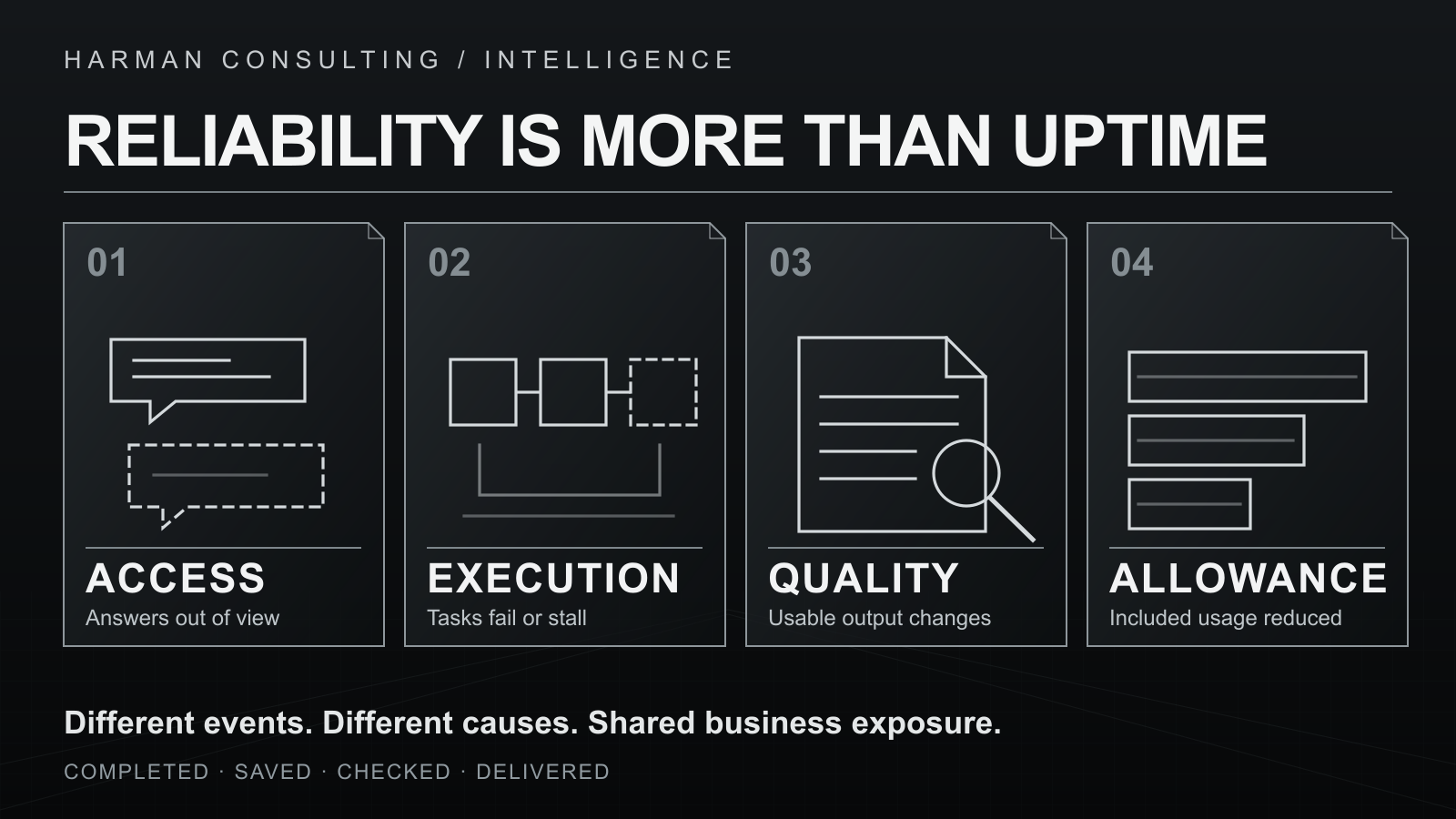
An AI subscription can remain active while the work built around it becomes harder to complete. Recent OpenAI and Anthropic records describe conversations and agent tasks that failed, pages that could not be edited, and usage controls that refused legitimate requests. OpenAI is also reducing the included usage of an existing $200 plan without changing its monthly price. These are different failures and decisions, but they meet at a business question: what dependable, recoverable work does a paid AI service actually deliver?
While preparing this report, the question became concrete. On October 15, a direct review of a shared ChatGPT research conversation showed my questions without the research replies or citations needed to check them. I reported similar missing replies in other cloud work that day. On October 16, the replies were visible in both the original conversation and the same shared link. The research returned to view, but it was unavailable when we first needed it. No account export or storage log in this investigation establishes why.
The documented incident record
The entries below are selected because they affected conversations, Work or Codex, stored content, usage controls, or research access. Each links to the provider’s incident report. A first and last status update is a reporting window, not necessarily a continuous outage. Both providers marked these incidents resolved; that does not verify any individual customer’s task or restore content that was never saved.
| OpenAI’s record | Anthropic’s record |
|---|---|
| Sept. 29 | |
| A feature rollout disrupted shared infrastructure. Some ChatGPT, Codex, and API requests failed or timed out; some conversations and tasks could not start, resume, or complete. Main customer impact was about 30 minutes, with residual degradation later that day. OpenAI’s incident analysis (opens in a new tab) | Claude chat, desktop/mobile, Code, Cowork, and API were affected for about an hour. Anthropic warned that some messages sent during the incident might not have been saved. Anthropic’s incident (opens in a new tab) |
| Sept. 30–Oct. 1 | |
| Plus and Pro conversations had elevated errors (opens in a new tab); a separate Space Pages incident (opens in a new tab) affected creation and interaction, with later reports of slowness and timeouts. | On Oct. 1, purchased credits were slow to appear in some Claude Platform balances, causing some requests to fail as if funds were insufficient. Anthropic’s credit incident (opens in a new tab) |
| Oct. 2 | |
| Some ChatGPT users encountered errors running code, analyzing data, or creating files. OpenAI’s data-analysis incident (opens in a new tab) | — |
| Oct. 5 | |
| Work and desktop Codex errors led OpenAI to warn that scheduled tasks might be affected. A separate incident disrupted saving and live editing in Pages; other reports covered some conversation and Codex Cloud errors. Work (opens in a new tab) · Pages (opens in a new tab) · conversations (opens in a new tab) · Codex Cloud (opens in a new tab) | Requests to Claude Mythos 5.1 and Fable 5.1 had elevated errors across chat, API, Code, and Cowork for about 30 minutes. Anthropic’s model incident (opens in a new tab) |
| Oct. 6 | |
| Elevated errors affected ChatGPT conversations, images, Spaces and Pages, API rehydration, and Dots. Later, some workspace agent responses were not appearing. Cross-product incident (opens in a new tab) · agent-response incident (opens in a new tab) | Claude Opus 5.5 requests had elevated errors across chat, API, Code, and Cowork. Anthropic’s Opus incident (opens in a new tab) |
| Oct. 7 | |
| A desktop-app version prevented new ChatGPT Work threads until corrected builds were issued for Linux, macOS, and Windows. Separate Dot incidents involved thread creation, failed turns, delayed responses, and reduced proactivity. Desktop-app incident (opens in a new tab) · Dot thread creation (opens in a new tab) · Dot turns (opens in a new tab) | Some organizations were incorrectly paused at a spend limit, and requests were refused across Claude services. Usage and rate-limit reporting also had errors or delays; Anthropic said core API requests were unaffected by that separate reporting issue. Spend limits (opens in a new tab) · usage reporting, resolved Oct. 13 (opens in a new tab) |
| Oct. 10 | |
| Some ChatGPT content was temporarily unavailable in the Android app while remaining accessible on the web. OpenAI’s Android incident (opens in a new tab) | — |
| Oct. 13–14 | |
| GPT-6.1 Sol in Work and Codex was degraded on Oct. 13. Work and desktop Codex had elevated errors again on Oct. 14. Oct. 13 (opens in a new tab) · Oct. 14 (opens in a new tab) | The usage-reporting incident opened Oct. 7 was marked resolved Oct. 13; Anthropic said core requests were not affected by it. Anthropic’s report (opens in a new tab) |
| Oct. 15 | |
| OpenAI reported a mobile-app login and signup incident and marked it resolved. The report does not say that conversation replies were removed or lost. OpenAI’s incident (opens in a new tab) | No Claude incident was used to explain the October 15 ChatGPT symptom. |
This record establishes that both services had recent problems; it cannot rank their reliability from a count of incidents. They define affected components and impact windows differently. The September 29 disruptions occurred at different times, and there is no evidence of a shared cause. OpenAI’s public status metrics are aggregated across tiers, models, and error types, so they also cannot certify what happened in one business account.
A research trail went out of view, then returned
The October 15 shared-page finding was a direct access failure during source review: the questions appeared, while the answers and their citations did not. My report of missing replies in other cloud work that day suggests the experience was broader, but those other chats were not audited one by one. On October 16, our review found the answers in the signed-in original conversation and in the same shared link. That rules out saying the research is still missing. It does not reveal what failed the day before.
OpenAI’s sharing documentation (opens in a new tab) describes different link scopes and snapshot behavior. Its missing-chat guidance (opens in a new tab) lists account, archive, loading, and incident checks. A data export (opens in a new tab) or storage records could help investigate a persistent absence; neither was used to establish the mechanism here. OpenAI’s separate October 10 Android incident shows why access and storage should not be conflated: some content was unavailable in one app while remaining accessible on the web. That resolved incident does not explain our October 15 experience. Nor does the October 15 mobile login incident (opens in a new tab), which does not report missing research answers.
The business consequence occurred even though the material later returned. We could not check the original research when the article needed verification, so we had to rebuild its source trail. The recovered ChatGPT reports are useful leads, but their claims still require checking against the underlying records. One report said the October 15 mobile-login incident was resolved at 17:41 UTC; OpenAI’s status record (opens in a new tab) says 18:56 UTC. Access to an answer and confidence in its accuracy are two separate requirements.
Paid terms, reasoning, and the work a system actually completes
OpenAI’s Pro-tier guidance (opens in a new tab) says eligible existing Pro 200 subscribers keep their previous included usage through October 29 and then move to a lower allowance at the same $200 monthly price. New subscribers outside that grandfathering window already receive the lower allowance. The notice I received identified Work and Codex as affected in my account. The public guidance does not quantify the old and new amounts, and a lower total allowance does not by itself mean each answer receives less context or reasoning. It can still change the volume and cost of work a business can plan to complete under the subscription.
Service quality also depends on the choices made around a model. On September 14, OpenAI retired automatic switching (opens in a new tab) from Instant to Thinking for Plus and Pro users. A difficult request left in Instant no longer automatically gets that higher-effort setting. That is a documented product change, not proof that a request explicitly sent at High secretly receives less reasoning. OpenAI’s memory-system description (opens in a new tab) also explains that useful facts are synthesized from earlier conversations. A stored transcript, a selected memory, and the information actually supplied for a particular answer are different things; the public description does not establish a universal reduction in the context available to paid conversations.
Anthropic has disclosed a clearer causal case. Its April 23 Claude Code postmortem (opens in a new tab) describes a change intended to reduce users’ cost and latency when resuming idle sessions. A defect repeatedly removed earlier reasoning after a session had been idle, and users saw forgetfulness, repetition, and unusual tool choices. Anthropic believes the resulting cache misses also contributed to faster usage-limit consumption. It fixed that bug April 10. The same investigation describes a lower default reasoning effort and a brevity instruction that harmed coding quality; both were reversed by April 20. Anthropic says the problems affected Claude Code, the Agent SDK, and Cowork, while its API and inference layer were unaffected. This is a documented example of an optimization and product settings reducing usable quality, not evidence that the same defect is operating now or that it caused OpenAI’s October failures.
The commercial question deserves scrutiny precisely because the causes differ. Claude’s October 7 spend-limit fault incorrectly refused requests; OpenAI’s earlier paid-plan capacity incident (opens in a new tab) says demand exceeded its available serving fleet for that incident. Its September 29 postmortem (opens in a new tab) instead attributes failed tasks to a feature rollout that exhausted shared network connections. These records show real limits in delivery. They do not provide the sales forecasts, capacity plans, or decision records needed to conclude that either company knowingly sold more than it could support, or that a revenue decision caused a particular outage.
There is no published date when every ChatGPT or Claude workflow will become dependable. A resolved status incident records the provider’s assessment of that named event; it cannot confirm that a particular task was saved, that an earlier answer can be retrieved, or that output quality has returned to the level a business needs.
Why this matters to an operating business
The research does not support a blanket conclusion that AI is a bad investment. A randomized study of 758 consultants (opens in a new tab) found 12.2% more tasks completed and 25.1% faster work across 18 tasks within the model’s tested capabilities. A field study of 5,179 support agents (opens in a new tab) found 14% more issues resolved per hour on average. Those results are not estimates for Harman Consulting or for any other business adopting AI. The consultant study also tested one complex task outside the model’s capability: AI users were 19 percentage points less likely to be correct, while their answers could be more persuasive. One such task does not yield a general failure rate; it shows why polished output still needs checking at consequential decisions.
In my own work, repeated disruption has consumed enough time that I described the month as lost productivity and said it was costing me money. That is a firsthand account of business pressure, not an audited loss total. Harman Consulting’s publishing work gives this report a concrete exposure map. A research question leads to source gathering, claim checks, an exact article edition, and image review. After approval, an article can move to website release; a separate LinkedIn link post depends on a verified public URL. Each stage depends on knowing which evidence and version it received. When the ChatGPT replies went out of view, review of the original research trail was blocked, although independent source checking continued. We later recovered the conversation, revisited provider records, and corrected a resolution time in the recovered report. The answers returned, but their later visibility did not give back the review time.
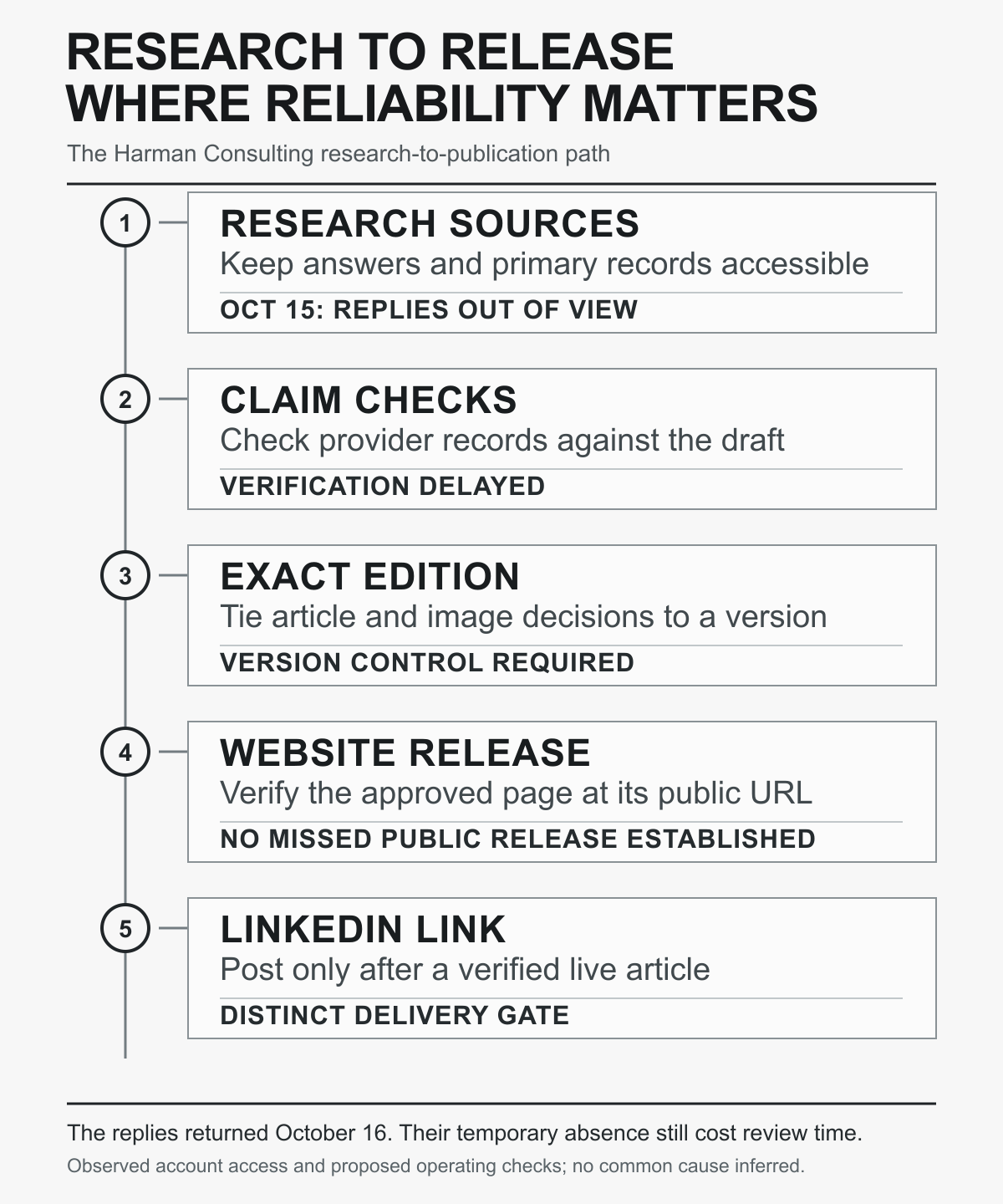
The same failure has different consequences in different businesses. An unavailable research answer can delay a publication; an agent task that never completes can hold up a customer response; a fluent but inaccurate answer can enter a decision unless its source is checked. In this report, we verified a temporary research-access gap and the need to rebuild part of the source trail. We did not verify a missed public release, a lost customer, or lost revenue. The point is to locate where the dependency sits and what evidence survives when it fails.
The business cost must be calculated for the affected workflow. Record recovery and review time, actual correction expense, any missed deadline with a measured consequence, additional usage charges, and the value of acceptable work AI completed. Avoid counting the same displaced hours twice or treating every delay as a lost sale. We do not have a defensible dollar total for the October interruptions in Harman Consulting’s publishing pipeline. The $200 subscription is one input, not the answer to whether the work is valuable or the disruption acceptable.
The immediate operating test is whether each critical route leaves evidence before a deadline: the source and answer used for research, the run record for a scheduled action, the exact approved publication copy, and confirmation from the public destination when it is released. A second AI provider or manual route is a meaningful fallback only if it can use those sources and finish the work in time. NIST’s AI Risk Management Framework (opens in a new tab) calls for monitoring, human oversight, and contingencies when consequential AI and third-party systems fail.
The record now contains provider incidents, documented product and plan changes, one verified Claude quality regression, an observed October 15–16 research-access gap, and business workflows with identifiable points of exposure. They do not form one proven causal chain. Together they make the subscription price an incomplete measure of value. A business also needs to know whether the work was completed, saved, recoverable, checked against the right source, and delivered by the time it mattered.
