
The work between Facebook attention and a job
Handyman Harman’s early marketing experiments show why campaign results, customer qualification and appointment costs need to be considered together.

Toward the end of our time with Angi, I was calling people who were already tired of hearing from contractors. Before we could discuss their project, I was dealing with the frustration created by everyone who had called ahead of me.
Originally, those customers had chosen our business and expected my call. Angi facilitated the introduction. As the service introduced more competing contractors, we became one of a group, and the group's behavior affected the conversation I could have with a customer.
That changed the value of the introduction. We needed an affordable way to meet people who wanted to talk to us about work we could do.
When we announced Handyman Harman on Facebook in our new market, that was the business problem behind the post. The boosts we've tried since then are helping us understand how attention, the website and the inquiry process can work together. They have also shown us where those connections still need work.
Start with the appointment
A lead has value when it gives us a reasonable chance to discuss a suitable project. For my business, cost per appointment is a more useful measure of that opportunity than the price of the introduction alone.
Cost per appointment = spending ÷ appointments generated.
From my recollection, Angi originally brought roughly ten leads a month, and I met about three out of five customers. Later, we were getting roughly four leads a month, and I met about one in ten.
The first combination would produce about six appointments. The second would average 0.4 appointments a month—roughly one every two and a half months. At equal monthly spending, that would make the cost per appointment fifteen times higher. Those inputs are approximate figures from my experience, but the relationship explains the problem: fewer introductions, with a much smaller chance of getting a meeting.
The math wasn't mathing.
It also wasn't only a pricing problem. The customer experience had changed before I entered the conversation. Looking at the whole path helped explain why something that once worked for us had become less useful.
Give each campaign a clear job
Facebook boosts gave us a manageable way to experiment while we were busy with other work. We could try a post, see the response and use that information to decide what to attempt next.
Our first announcement introduced the business in its new market. My intention was to bring people to the website. Meta's recorded campaign goal was “Get Page visits and follows,” and we also brought people to the Facebook page and gained follows. That helped us establish an audience alongside the inquiries I received.
Next, we boosted Catio Job Economics, a post about the economics of building an outdoor enclosure for cats. This time, the selected goal was engagement with the post. It drew far more reactions and shares than the announcement, but no job inquiries.
Then we reused the announcement with page follows as the aim. We'd replaced the original photograph with a cleaned-up version we were happier to keep on the page. The rerun brought another two or three inquiries, although it didn't reproduce the first response.
| Measure | First announcement | Catio Job Economics | Announcement rerun |
|---|---|---|---|
| Spending | $49.85 | $48.84 | $35.53 |
| Reach | 6,035 | 4,771 | 2,151 |
| Post engagements | 555 | 2,064 | 137 |
| Reactions | 97 | 1,967 | 72 |
| Shares | 5 | 29 | 8 |
| Saves | 16 | 16 | 9 |
| Link clicks | 431 | 21 | 47 |
| Job inquiries, by my count | 6 | 0 | 2–3 |
The campaign figures come from Meta's lifetime paid campaign reporting. The inquiry counts are mine and include contacts through other channels; they aren't Facebook's attributed lead totals. We don't have appointment totals for each boost, so this table doesn't establish their cost per appointment.
The first announcement also recorded 713 page visits and 109 follows. The rerun recorded 120 “follows or likes,” labeled Facebook likes in the breakdown. Those are different measures, so they don't give us a direct comparison of new followers.
Once the intentions are clear, the results become more useful. The catio post attracted engagement around a subject. The announcements introduced a business people could contact. Each contributed something, but the larger reaction count didn't tell us which would bring a worthwhile customer conversation.
Attention needs a useful next step
The catio response gave us something worth building on. Nearly two thousand reactions, twenty-nine shares and sixteen saves showed that people found the subject worth responding to and passing along. It gave us more presence and a basis for our marketing approach.
It produced no immediate financial return. Future value may come from that exposure, but we haven't yet seen it turn into a job inquiry.
That leaves a design question: how can the interest we've attracted connect to work someone wants us to do?
The subject, timing and audience all matter to that connection. We were heading into fall, when catio construction wasn't the work we wanted to pursue. The catio campaign also used a United States audience setting, while the first announcement used local targeting. A post can be interesting to people who have no current reason to hire a local carpenter.
Those are possible explanations, rather than a diagnosis of who responded or why. We changed the subject, imagery, audience and campaign objective across these attempts, so we can't isolate the cause of each result. What we can do is use the response to make the next attempt more relevant to our services and the season.
The inquiry process helps qualify the interest
The next connection is on the website. A post can help someone notice us; the site gives them a place to understand the business and consider whether we're suited to their project. The inquiry form then asks them to explain what they want done.
That last step matters. In my experience, Facebook inquiries often remain conversations. People who complete our website form are much more likely to be serious, and I almost always get an appointment to meet them.
The form is designed to filter for that seriousness. It gives us enough context to begin discussing a real project. Increasing the number of messages would be of limited help if those messages didn't improve our chance of arranging a worthwhile visit.
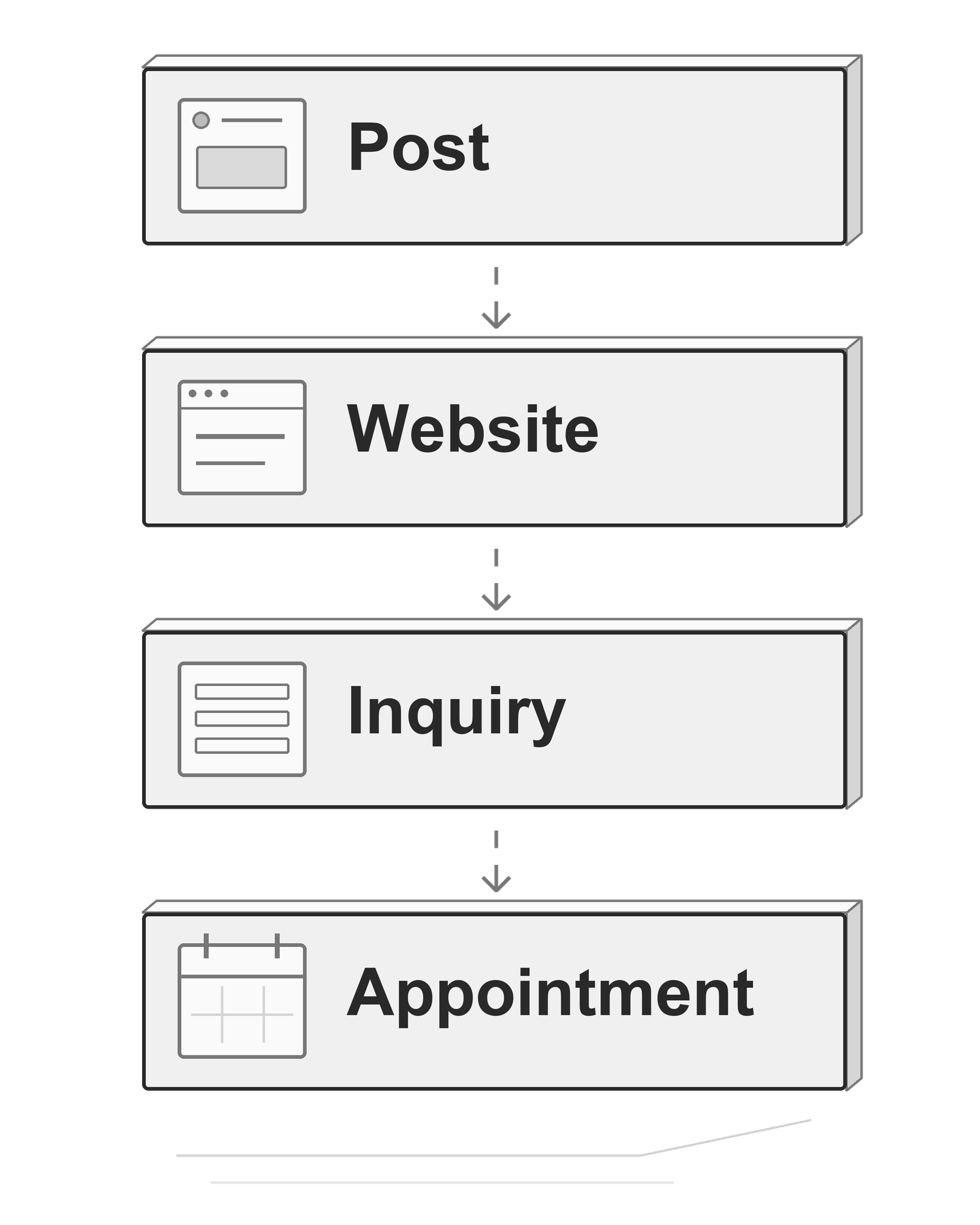
This is where I see the ecosystem at work: the post, website, form and appointment each help a person move through a different part of the decision. Their relationship deserves as much attention as the individual post or page.
A visit doesn't establish a completed inquiry, and an appointment doesn't guarantee booked work. We need to understand where interest continues, where it stops and whether the next step helps both the customer and the business. The useful question is what each connection allows someone to do.
Put the learning into the next campaign
Even while we're developing this approach, we're lucking into more viable leads than we were getting through Angi, at about one-fifth of the cost. That's my assessment of the inquiries reaching the business and what we're spending. For us, this is already much better.
People can discover the business, see our work and choose to contact us specifically. That gives us a better starting point for the conversation.
Now we want to make that approach more dependable. The next campaign should connect the artwork and style we've been developing with our core business: carpentry, custom carpentry and furniture, including work we can do through fall and winter. Our home improvement and history research has given us job ideas to share; those ideas need to help people recognize projects they might bring us.
Dedicated Facebook ads are likely the next experiment. Boosts have been easier to fit around other work. Google advertising remains a later step, once this approach is bringing in enough regular income to make that investment a priority.
You can see the services, projects and inquiry process on the Handyman Harman website (opens in a new tab), and the posts and their visible responses on our Facebook page (opens in a new tab).
For another business examining its own marketing, I'd start with the outcome that makes the effort worthwhile, then follow the connections that are supposed to produce it. What helps someone discover you? What helps them decide you're relevant? What makes the first useful conversation possible?
Our experiments have given us different pieces of that answer. The work now is to connect them: carry what people respond to into an offer that fits our business, give that interest somewhere useful to go, and learn from the appointments that follow.
