
However beautiful the system
A month of Facebook posts helped me recognize what my system could already do—and where it still needed work.

“However beautiful the strategy, you should occasionally look at the results.”
I've used that line in presentations for years to explain why analytics matters. I attributed it to Winston Churchill. In checking it for this article, we found that the International Churchill Society lists it among quotations falsely attributed to him (opens in a new tab). Even the quotation needed checking.
The advice came back to me while I was looking at a system I'd built to help market my handyman business.
At a glance
- Scheduling 29 days of posts in one chat showed me that my original marketing goal was already within reach.
- Reviewing the skills exposed repeated quality checks that were making the work take longer.
- Changes such as removing an article need their own workflows, including what happens to the rest of the schedule.
The job I started with
My original plan for Handyman Harman was straightforward. I would write the articles and automate the posting. Creating and publishing one item at a time took too long. I wanted a reservoir of articles I could rotate through so the business could publish consistently without marketing taking so much of my time.
The first attempt ended with a computer crash before I got that posting process off the ground. When I started again, the work involved learning the process well enough to explain it to ChatGPT.
We began with an all-in-one Facebook post creator skill: a set of reusable instructions for doing the job. Neither ChatGPT nor I could get posting to work the way I wanted. We had to walk through it. Along the way, the distinction between Facebook ads and ordinary posts became important. I returned to posts because that process was more familiar to me.
I had to learn how to use Facebook so I could teach ChatGPT how to use Facebook.
At first, we were talking through articles and simplifying them. The more formal work on voice came later, along with editorial guidance and business standards. Each had a purpose, and they had to work together. An article needed to sound like me, communicate something useful, and meet the requirements of the business it represented.
That was where the work began expanding into a system. I wanted to use what we were building across projects, selecting the appropriate voice and editorial instructions for each workflow. One skill became several. I was engineering a more structured process that could support more than the original Facebook task.
The month I could already schedule
I had asked ChatGPT to research ways to handle posting, and that led us to Meta's scheduling tools. I'd had reservations about that approach because of the work involved in handling Facebook and Instagram separately. Once ChatGPT could help do that work, the same objection carried less weight. The process could be useful even if it wasn't the way I would have chosen to do everything manually.
The result became clear after a conversation with a friend. I was telling him how much time I spent on marketing. Then I went home and, in a single chat, had ChatGPT schedule a month's worth of posts through Meta.
We scheduled 29 days. I'd wanted to go farther, but that was the scheduling window we were able to use in that setup. The remaining articles could stay in Airtable until it was time to schedule more.
For that month, the posting work was done. The posts went out, and I had no issues with that batch.
That was a huge result. Consistent posting with less work from me was what I'd originally wanted. I think I could have reached that point a month or two earlier. Instead, I'd continued building: developing Harman Consulting, reviewing case studies, refining the system, and working on getting skills launched.
I already had enough to accomplish the original goal, but I had kept building before putting the posting workflow to use.
There was value in the other work, and I wanted to keep doing it. But when I described all those hours as time spent on marketing, I was losing track of how much the assignment had grown. Scheduling the month gave me a concrete result to compare with the original request.
It also encouraged me to document the work through Past Life. I could see enough working to have something worth sharing, even while the workflows themselves were still being developed.
Reinforcement sometimes meant removing steps
As the work spread across projects, I needed a clearer view of what the skills were actually doing. The Skill Blueprint came first. It let me examine the steps inside the skills and find duplication.
I'd been cautious, so I had put quality checks in multiple places. The work would be built and checked, then built and checked again, then checked again further along. The results worked, but reaching them took longer than necessary.
Seeing those steps together made the redundancy apparent. In the workflow I was reviewing, I could consolidate those repeated checks into a single QA pass. That was an improvement I could make by removing work. It also led to automating reviews of the skills themselves for redundancy and the order of their steps.

The Service Blueprint came next, giving me a view of the whole process as the skills connected. That work is still developing, and I see the agent side as the next level.
The pattern has been learn, build, reinforce. Sometimes reinforcement means adding a missing instruction. Sometimes it means discovering that several instructions are making us do the same work repeatedly. Voice standards have needed repeated attention as I've applied the process to different projects.
A schedule has to handle removal, too
Scheduling is still one of the areas that needs work. ChatGPT has repeatedly changed posting dates, and Airtable has been important for keeping track of the articles and the dates assigned to them.
The difficulty becomes more visible in Harman Consulting, where I'm continually writing new articles and changing what needs to be published. If I insert a timely article about a ChatGPT outage, the existing articles need to move. The change has to carry through the schedule while respecting which days are available and which types of articles belong on them.
Removing an article needs a corresponding workflow. That became clear when taking one out left a hole instead of bringing the later articles into the earlier slots.
For a simple example, suppose an article is scheduled for October 2 and another for October 3. If I remove the October 2 article, I want the October 3 article to move into that opening, then the following article to move into the next opening. The dates need to move back and close the gap. In the actual calendar, those moves also have to follow the rules for eligible publishing days and article types.
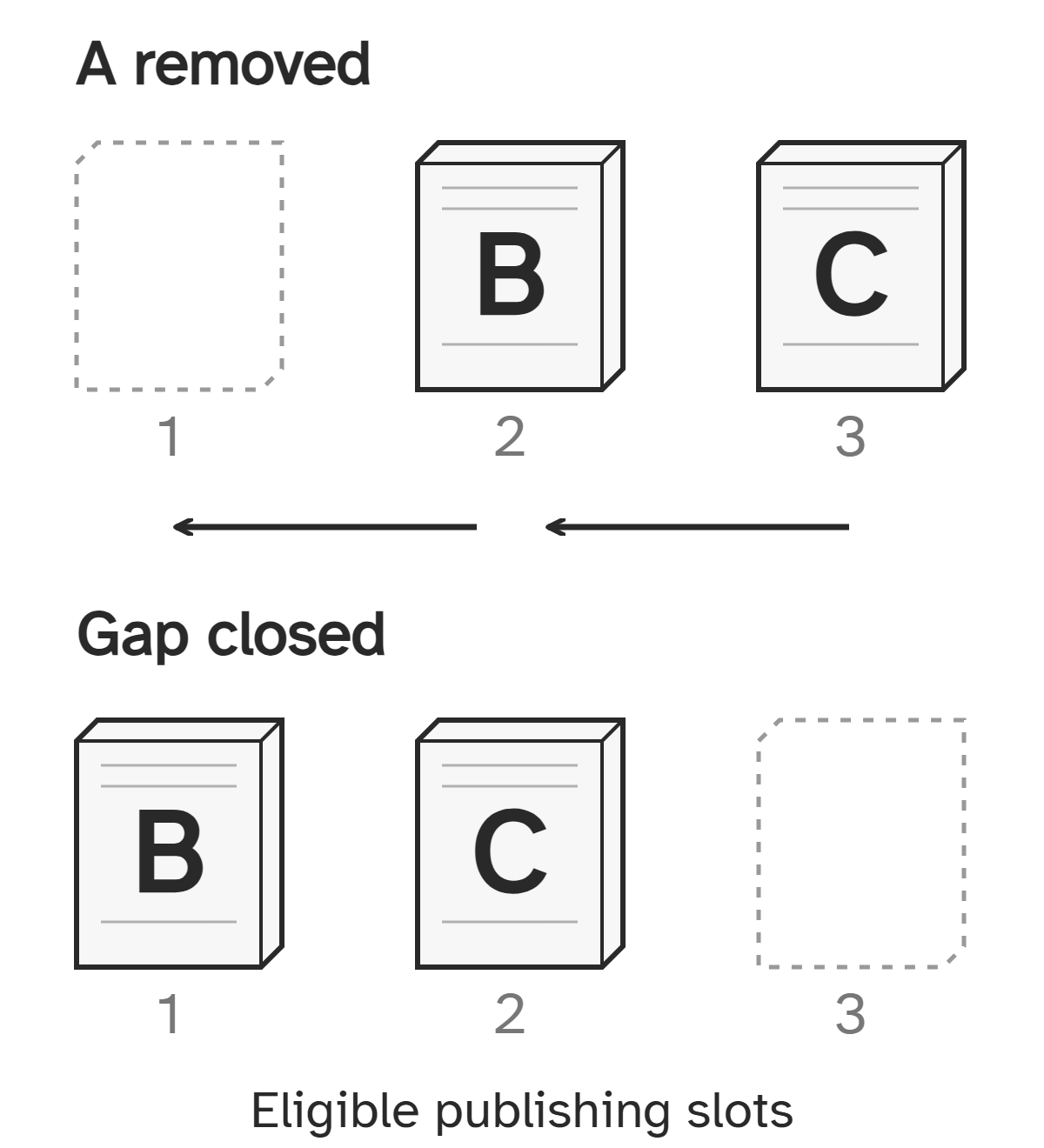
That's a negative workflow: what happens when something is removed, fails, or can't proceed as expected. I've seen people overlook these paths in human processes, too. We describe how the work should move when everything is available, then leave out the defaults and actions needed when it isn't.
Those paths have to be part of the instructions. I'm still working through them. Having a month of Handyman Harman posts scheduled gives me room to do that without holding up the whole posting cycle.
The monitoring has its own weakness. ChatGPT interruptions have made my checks that posts went live unreliable at times. Once Meta holds the schedule, though, publishing can continue independently of those checks. A missed monitoring check and a missed post are different problems.
What the result lets me do
I haven't stopped building. I've been able to focus on other projects, including an experiment with visual articles that are essentially comics. I'm also returning to the apps and digital products I wanted to build to help with my handyman work.
The editorial work has made another project feel practical: a Handyman Harman blog. I'd wanted to do that for a long time, but it hadn't seemed worth the effort. I'm going to use what I've learned through Harman Consulting to launch it.
The broader system will continue to need maintenance and revision. That doesn't prevent me from using the parts that already do their job. The original posting goal has a result I can point to: 29 days scheduled in one conversation, with the posts going out as intended.
I've spent years using that quotation to remind other people to look at their results. This time, checking my own showed me that I could already use what I had built.
