
My first AI skill was blocked. Now what?
Voice Development began as a way to carry writing decisions forward. Trying to distribute it has opened a different question: how do we turn useful skills into services people can use and support?

I expected the follow-up to my writing article to come after we launched the skill in OpenAI’s directory. That would have given the story a convenient ending: here is what we built, here is what changed, and here is where you can find it.
Instead, we reached a message that leaves the next step unclear:
We are not accepting more skills-only submissions at this time.
We know what the message says. We still don’t know why that restriction is in place, how long it will last, or what would allow our submission to proceed. Waiting for those answers has become part of the story, and I don’t think the article needs to wait with it.
The skill itself is already available to try. In Why I kept correcting my AI drafts (opens in a new tab), I described how writing samples, conversation and review helped me develop instructions I could carry into later work. The article’s Try it with your own writing section (opens in a new tab) includes the free Voice Development download and directions for using it. You can download it yourself and give it a try without waiting for the directory submission.
What we were trying to share
Voice Development is about written voice. It helps an assistant examine supplied writing, show the evidence behind its observations, and develop a Voice Profile for the author to review. The downloadable package contains the method and synthetic examples. It does not contain my personal profile, or automatically give someone else my voice.
The original article explains why I wanted that process. I was working across projects with different audiences and purposes, and repeatedly correcting drafts was consuming time. Some corrections belonged in the article in front of me; others needed to change the instructions used for the next one.
Making the method available was a small first experiment in sharing that work. A directory listing looked like a useful additional way for people to discover it and try it in their own environment.
The download page explains how to get started and what to expect. You’ll review the assistant’s observations and the resulting profile against your own writing.
The work around the skill
Preparing the submission exposed work beyond the writing instructions. The product needed a clear identity and a sensible destination on the website. People needed to know where to get support and find the privacy policy and terms. We also had old links and website issues to investigate.
That work mattered even before anyone found the skill through a directory. If I invite someone to use a resource, the surrounding information needs to make sense. The article, download, support route and policies are all part of that experience.
An earlier submission was observed in review and later marked Changes required. Our saved inspection did not capture a specific explanation for that decision. We addressed the website and policy gaps we could identify, but I can’t say those gaps caused the earlier outcome.
The skill passed the automated checks, but we’re blocked from submitting it to OpenAI’s directory. We still don’t know why the restriction is in place.
Passing automated checks clearly did not mean we had permission to publish. OpenAI’s plugin guidelines (opens in a new tab) distinguish skill scanning from additional eligibility requirements for directory distribution. Passing those checks does not guarantee that a submission will be accepted. It does not explain the restriction on our submission.
What the research could establish
I wanted to know whether this was a familiar pause, a capacity problem, an account issue or a permanent change. We searched the official documentation, developer discussions and other publishers’ accounts of their submissions.
There is evidence that someone else encountered the same message. The maintainer of Scala Semantic Harness (opens in a new tab) recorded a skills-only refusal on October 12 despite passing checks. That is another publisher’s report, not access to their account or an official explanation. It gives us a reason to investigate beyond our own package without establishing how broadly the restriction applies.
As of the October 21 research, we had found no authoritative reason or reopening date. We also had no basis for saying that OpenAI was overloaded, that these pauses happen regularly, or that the opportunity had closed permanently.

Those unanswered questions will stay in the monitoring work. Meanwhile, another question has become more useful: what can we deliver without making every next step depend on this directory?
From a download to a service
The free download already gives people one route. They bring the method into an assistant they use, supply their own samples and review the result. A hosted service would ask us to take responsibility for more of that experience.
For Voice Development, we would need to decide how people supply writing, review interpretations, save an approved profile and return to it later. We would also need to handle access, storage, support and operating costs. Hosting the process would create work that the current download leaves with the person using it.
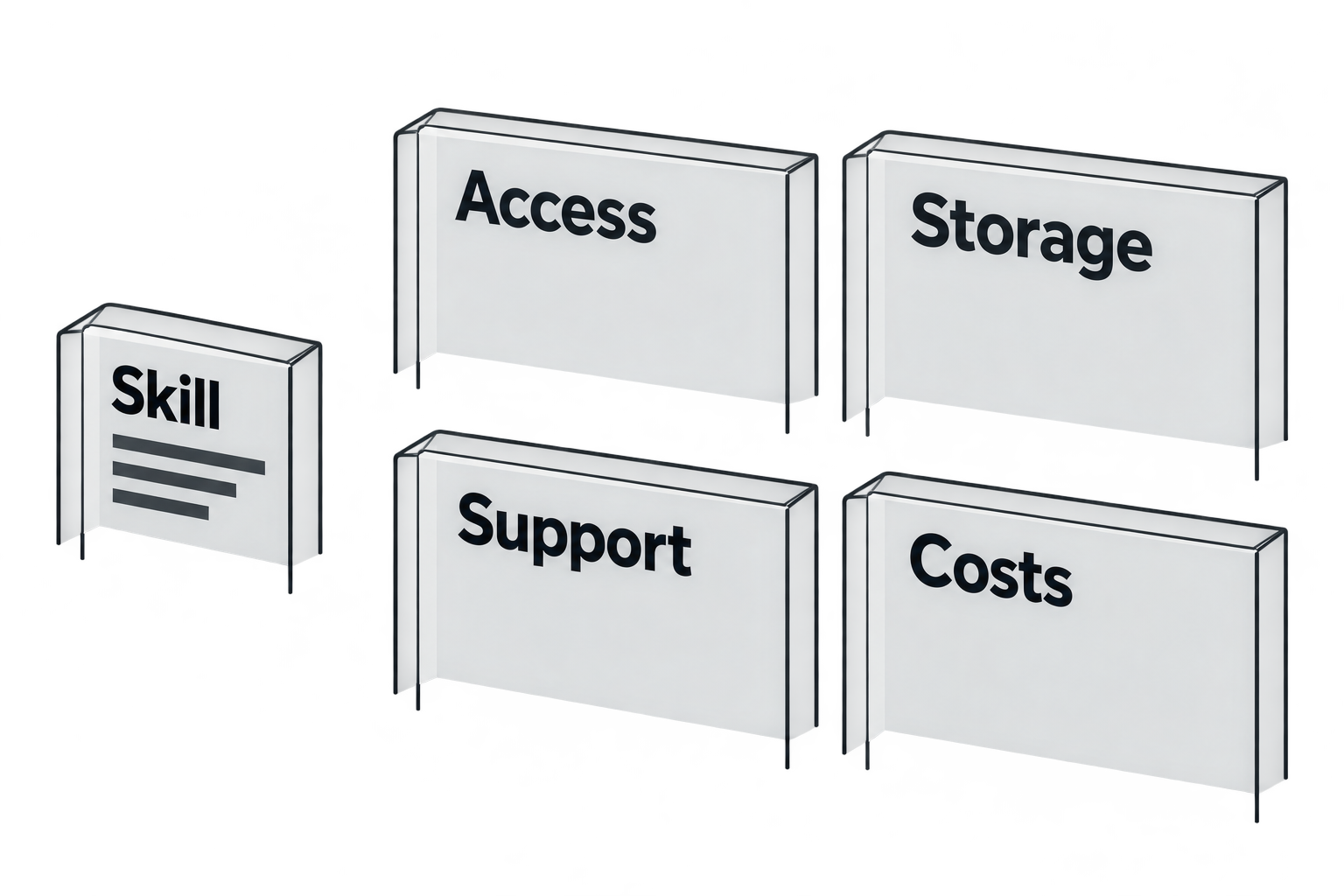
There are related possibilities in the workflow audit and blueprint skill, and in ScopeForge, which we are developing around turning project information into reviewable scopes. Each needs its own evaluation. A useful method in our work does not establish that another person wants a subscription, or that a hosted application is the right way to deliver it.
My first commercial target is modest: recover the $200 a month I’m spending on ChatGPT. Even that requires more care than counting $200 in sales. We need to account for delivery costs and the time spent helping people use the result. An API-based service also brings separate usage charges; OpenAI bills the API separately from ChatGPT subscriptions (opens in a new tab).
I want to learn what people find useful, what takes assistance, and what it costs to provide a result they can use. We have not established paid demand or recovered that subscription cost through these skills. Those are questions for the next experiments.
Reporting what happens next
This is the direction I want Harman Consulting’s intelligence work to follow: questions that arise from using these systems, researched far enough to support an actual decision. That includes the restrictions we can verify, the options that remain available, the costs of trying them and the outcomes of our own tests.
I’m developing this into a regular intelligence stream. Thursday is the day I’m considering for those articles. The point is to report what we learn as the work develops, including where an answer is still missing.
We’re still trying to launch Voice Development in the directory. That attempt remains blocked, and we don’t yet know why the restriction exists. In the meantime, the original article has the download and instructions (opens in a new tab). People can try the method now, and we can keep learning how to make the next version of the experience useful.
