
Weekly Job Intelligence: Did AI make the whole job easier?
A quick draft is useful. New workplace research and a current employer posting point to a broader skill: showing what improved for the people doing the work.

Picture a team using AI to prepare customer replies. The first draft appears almost immediately. Someone still has to check the account, correct an assumption and find the person who can approve an exception. The customer is waiting for an answer, while the team is admiring how quickly it now produces drafts.
That is a hypothetical example, but it gives this week's research a useful question: did the whole job get easier? A faster first draft can be quite an efficient way to build a larger queue. I'd want to follow the work far enough to find out what happened next.
What the new reports actually say
Lenovo's November 10 workplace report draws on an August survey of 1,200 IT leaders at organizations with at least 1,000 employees across 12 countries. Only one in ten reported a continuous approach that connects AI use to workflow results and uses those findings to choose where to invest. That is a specific measurement practice, not a finding that everyone else measures nothing. Lenovo's report announcement (opens in a new tab)
There is encouraging evidence alongside that gap. Kyndryl's report, also announced November 10, says 64% of the 3,700 senior business leaders surveyed across 21 countries reported positive returns from AI investments. Yet only 27% had formally changed roles and responsibilities around AI, and 29% had fully implemented change management for its adoption. Benefits and unfinished organizational work can exist at the same time. Kyndryl's findings (opens in a new tab)
Both are vendor-sponsored surveys of reported experience. Their different questions and samples cannot be combined into one score, and they do not prove which changes caused a return. They do give you a reason to look beyond whether a tool is being used and ask what it helps people finish.
The skill appears in the work itself
Habitat Health's Senior Associate, Product Strategy & Operations posting makes that connection unusually concrete. It asks for someone who can observe work in care centers, map a process, build a useful tool and stay involved through training and adoption. The measures include throughput, time, quality and administrative burden. The employer's posting (opens in a new tab)
This is the same role checked in last week's research, still present on November 16. It is one permanent position, not evidence of a new wave of hiring or an available consulting contract. What interests me is the combination of responsibilities: understanding a problem, making a change and finding out whether people benefit belong together.
That is useful guidance for someone developing their skills. A demonstration that generates a document shows one capability. An account of how you found a recurring problem, tested a change and checked the result shows more of the work an organization needs. It also gives a potential collaborator something specific to question.
Follow one task to the end
Here is a small exercise I'd try. Choose a routine task you are allowed to examine, such as preparing a standard internal report. Define its finish from the recipient's point of view: the report has been checked and can support the decision they need to make.
Before changing anything, observe several comparable examples. Record the time from request to usable result, the effort spent checking or correcting it, and the problems the recipient still has to resolve. Include waiting time. A report that takes little effort to draft can still arrive too late to help.
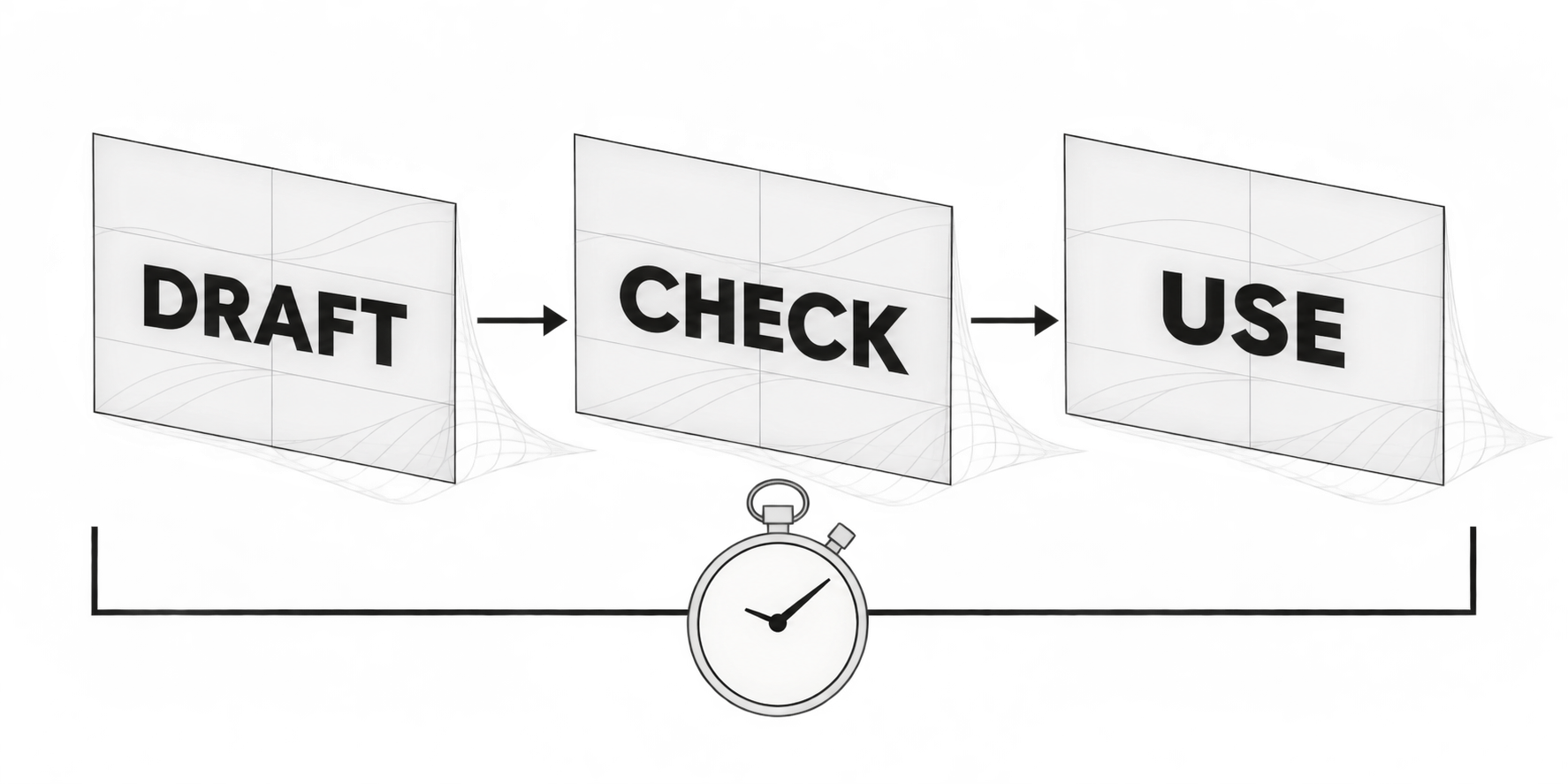
Then test one change on similar work and keep those same measures. If preparation gets faster but checking takes longer, investigate what moved. Perhaps the instructions need better source material. Perhaps a person still needs to make a judgment the tool cannot supply. Or perhaps the change works well and deserves a wider trial. The comparison should leave room for any of those answers.
Keep the example small enough to explain clearly: what happened before, what you changed, what you observed afterward and what remains uncertain. A small trial can inform your next decision; it cannot establish an organization-wide saving. This is a suggested exercise, not a test we have completed for the companies above.
For an organization, that kind of evidence helps decide where to invest another week of effort. For a practitioner, it demonstrates observation, design, testing and follow-through in one piece of work. The useful question becomes much more concrete than whether someone is good at AI: can they show an improvement another person can actually use?
Where has a quicker step in your work helped the whole task—and where has it simply moved the waiting somewhere else?
